Showing posts with label Boundaries. Show all posts

Sunday, March 16, 2014

Final Essay

           During the 19th century, the Western Expansion preoccupied the minds' of most Americans. After the acquisition of the Louisiana territory, American nationalism was at its peak as all of America scrambled throughout to turn the belief in Manifest Destiny into a dream come true. This directly resulted in the Transcontinental Railroad, which became the perfect solution to join the West coast and the East coast. During one of the greatest movements in history, Robert Grainier, a character in Denis Johnson's novella, lives on the Western frontier while experiencing this historical movement in terms of De Certeau's Spatial Stories. Michel De Certeau's Spatial Stories reinforce the definitions of words we may use every day, but may not understand the true meaning behind. There's a fine line between certain words that calls for the need to specifically differentiate one from the other. A clear example would be the words "space" and place" or "frontier" and "threshold." Although both sets of words have similar context, both are of different origin and define completely different subjects. Even words that must exist with its counterparts like how each "frontier" consists of a "bridge" is clearly explained in Spatial Stories. De Certeau's Spatial Stories act as a guiding vessel in the employment of the overarching concepts of the spatial stories explored in Train Dreams. In addition, the questions of what is a space, place, threshold, bridge, and frontier can be proven by Johnson's text, which allows for a better overall understanding of what Train Dreams and Spatial Stories is about.
De Certeau defines space as an area where the existence is created by the activity that defines it so. The definition of place is the establishment of space. Therein place only exist after space is created and recreated over again with the same purpose in mind. Such that Grainier’s home would represent something that is a “place,” while “space” would be that of the entire town of Moyea Valley. In that the daily activities of the townspeople would create what a “town” is. Space can contain places, but in theory, it space is the creation of place. An example would be how Grainier can live in Moyea Valley, but the Valley itself can change due to external causes. Although the valley can change, the location in which Grainier chooses to live will still be his home. An example in the novella would be when Grainier’s cabin burned down, even though his cabin is gone, the concept of home is not. As long as Grainier rebuilds this cabin on the same plot of land and resumes doing “home” activities, it will still remain as a definition of home. This applies to space, too. Grainier had participated in various locations throughout the novella to aid the development of the railroads. Each location he had worked on would be considered as one of De Certeau’s space. This is due to the fact that each space is occupied for different reasons. His occupation as a logger, for example, led him to occupy a forest. In that moment the forest is still a forest, but once it is cleared, it becomes another space. Because they are occupied only for the moment, they are interchangeable. Thereby abiding De Certeau’s law of space.
If there exist a difference in space and place, then there is also a difference in frontier. In which frontier is usually confused as a simple border separating two different geographical regions of space.  Through short stories, Johnson confirms De Certeau’s explanation that a true frontier is not just a border that separates, but also a bridge between two unique spaces. Thus one space can and only will exist when both frontiers and bridges exist. This can be proven throughout Train Dreams in the series of events in Grainier’s life. The definition of what is human only exists because there is also a definition of what is not. In reference to Train Dreams, there exists normal people like Robert Grainier or Kootenai Bob and the rest of the townspeople and there exists animals, like the wolves and the wolf-girl. Through this intangible frontier, there is a bridge. Because of the separation, there is also a link in between the gap. Without humans, animals would not be considered animals. Without animals, there would not be humans. Therein it is necessary for a bridging between both characterizations for the formation of a frontier. Another example would be the existence of the individual. There can only be a “self” if the opposite of “self” (everyone else) exists. Grainier becomes a unique character, not because of his past sufferings, but because of his unique mentality. In an abstract sense, Grainier has his own “self” and becomes this individual because no one else has the same outlook as him. An example would be Claire Thompson. Both she and Grainier were widowed within a few years of marriage. Although both experienced similar tragedies, both deal with their situation uniquely. In which Grainier wallows in his past and Thompson moves on towards the future. Each character deals with similar experiences in their own unique way. The bridge between these two characters would be the death of their significant other. The frontier that exists would be their mentality in dealing with the actual situation. Even in the internal battles within the self, Johnson clearly outlines that there is the existence of a frontier, as well as a bridging between the gaps of the two differences. Grainier battles with the differences of reality and fantasy repeatedly, throughout the mini novel. In which, he has recurring encounters with the ghosts of his past. In the near real life encounter with the ghost of his wife, he reinvents her last moments in the cabin long after she dies, yet he is able to picture the entirety of the event in a realistic manner. In Grainier’s fantasy, he cannot separate the difference between reality and fantasy. This illustrates the underlying message that Johnson tries to recreate, in that there is a fine line that a frontier creates. This frontier divides, but presents the opportunity for a bridge to form between two different concepts with similar ideas. Similarly so, Grainier also stumbles across another man who may knowingly or unknowingly battle with reality and fantasy. Mr. Peterson had reassured Grainier that his gunshot wound was the result of his dog shooting him in self-defense. In reality, the occurrence of such event is not very likely. Even Grainier who can be a bit of a simpleton, questioned Peterson’s story. The question of what is real and fake can only exist because of the “frontier” that exist. This frontier can only exist when the bridge that defines what is related also exists. In this situation the relationship between truth and lies establish this bridge. Truth is related to lies in that they both are the counter definitions of each other. Therefore, reality is directly proportional to truth, just as lies are to fantasy.
          In terms of frontiers, bridges, spaces and places, the subject matter of threshold comes into question. Thresholds can be defined in many different ways. The definition that usually comes to mind is any place or point of entering or beginning. In De Certeau’s definition, a true threshold is any occupiable transitional space. This can be applied to Train Dreams. Tangible thresholds would be the land reserved for the Western Expansion. Because of the concept of Manifest Destiny, each space was kept in mind as a space for transition. In that a place that was once a forest may be cleared to form a space, in which the loggers will occupy. After all the trees are chopped down, the space can perhaps become a place for railroads to pass through. Because of this establishment, it can also lead to the development of a town due to the settlers that may build their homes in the surrounding area. The possibilities are endless. The infinite potential illustrates how malleable this space is. Therein creating the idea of a threshold, since the space is so flexible, it is always in transition.
Through each story a little more of the Valley of Moyea is uncovered. We begin to see the Spatial Stories that De Certeau speaks about through Train Dreams. In which, we are then able to understand the distinct definitions to the words with similar context, such as the words, space and place. Not only the similarities of words are explored, but also words that represent opposites like frontier and bridges are brought into the light. The creation of such distinct spaces, places, frontiers, and bridges, allow for the existence of thresholds. Using Train Dreams and the stories told within the novella, we were able to differentiate and categorize each story to assemble a distinct definition with clarity.
Source: Photo

Sunday, March 2, 2014

TRAIN DREAMS & DECERTEAU SPATIAL STORIES - OUTLINE

- TOPIC: SPACE, PLACE, THRESHOLDS/TRANSITIONS, PATHWAY

               - DE CERTEAU and the definition of what space and place is: space is defined the bodies inside
Frontiers here act as the transitional space where it eventually stabilizes and turns into an official place. A place is something that is stable. The people there act specifically and according to.

                              - EXPANSION TO THE WEST
                              -DIFFERENT PLACES. HOMES. SCENES.PEOPLE HE MEETS/THEIR BACKGROUNDS.
-HOW SPACE ALWAYS CHANGES. A STANDING THRESHOLD. DEPENDING HOW PEOPLE USE THIS AREA?
WHAT IS A TRUE THRESHOLD? WHAT ARE THE THRESHOLDS IN TRAIN DREAMS? HOW ARE THE PEOPLE IN GRANIER'S TRAVELS INVOLVED WITH THRESHOLDS?
 WHAT IS SPACE? WHAT IS PLACE? HOW IS EACH AREA DEFINED AS PLACE/SPACE?
-DOES A CHANGING SPACE CATEGORIZE AS A THRESHOLD?
                              - Minor Questions - How did they build the western expansion? How/Why did                                    they choose the pathway? How do pathways cross?
                              - How were the people affected? How did they change the space they                                               occupied?
                              - WEST meets EAST. transitional/Moving systems are the thresholds.
                              - Moving systems act consciously creates a place
-Train Dreams. Spatial Stories. How the West expanded. How things change. The historical lost of each space.
               -HOW DOES SPACE MAKE PEOPLE BEHAVE? - Forced to interact and cooperate to create this                railroad.
               - How does the hardship during the western expansion affect the personal life of Robert Granier and how does this draw connections to space and place?
               - PATHWAYS/THRESHOLDS. AREAS THAT ARE CLEARED EX FOREST. (For the purpose of building a             path to connect to the ends together)
- Manifest Destiny -
"That westward expansion was greatly aided by the completion of the Transcontinental Railroad in 1869, and passage of the Homestead Act in 1862. That act provided free 160-acre lots in the unsettled West to anyone who would file a claim, live on the land for five years and make improvements to it, including building a dwelling."
-THE CULTURAL ASPECTS - Racism. DID IT AFFECT THE SPACE/PLACE
-Juxtaposition to show analysis. (Small stories) The man and the dog. Granier and land. Etc.
-Story progression
               -The American Dream and Western Expansion
               -His own dreams. The spaces created.

-Other specific moments...

Tuesday, February 11, 2014

Focault's Docile Bodies and Architectural Related Studies at Pratt


The space I chose is one of the freshmen dormitories on Pratt’s Campus. The Cannoneer court is designed in the most efficient way possible. In that there are two sides to the dorm, one mainly for the girl population and the other for the male. Both sides have access to the other side through the main lounge, workroom, and the lobby. Upon entering the Cann (as we call it) one will turn left, turn right, or walk up the stairs to the next level. In this journal entry, we will be focusing on the second floor of the Cann, particularly the girl’s side of the hall and the spaces that intersect the hall. With 22 rooms down one hall, there are approximately 44 girls living on one side of the second floor. These girls all share one bathroom at the end of the hall and a workroom along with a main lounge with the whole building.
Through the spatial organization, one can infer that there are only two directions to go to. One is to the communal restroom and the workroom, while the other is to the lounge and exit. Through this organization, there is no other space for the residents to wander off too. The narrow path down the hall suggests that it is not a place for communication. The horizontal pathway only allows two directional movements. If one must communicate in a comfortable manner, it can be done through the workroom or the lounge, which are on either ends of the hall. In this hall, there are many rooms. Each room is spaced approximately five to ten feet away from each other and is accessible only through the doors in the hallway. The placement of each door not only allows for each person to have equal amounts of space within the vicinity of the room, but it also exacts control over the residence. This idea is similar to Focault’s theory on how repetition and partitioning will break down collective dispositions and create useful space, as well as create equal standing among all. No one person has power over another. The shared lounge space and workspace are to encourage communication between those that live in the same building. Although communal restrooms are an inconvenience, it promotes communication because of the forced interaction with your neighbors. This enables freshmen students to create strong bonds with those who live in the same floor. With so many students living in the same hall, security is definitely a concern. Each door is equipped with its own lock system. Similar to Focault’s discussion about Jeremy Bentham’s Panopticon, the lock system, even if it is not actually in use, act as a barrier between the shared space and personal space. It provides legible boundaries, in the sense that not one person will enter another’s room, even if they know that no one is occupying the room at the moment.  There is a blind trust between those who live in the same place and share the same space. Residential advisors live on either end of the halls. This employs the idea of ranks to keep the population in control when needed.


Tuesday, February 4, 2014

"Spatial Stories" and "Tintern Abbey"


Human interactions, within certain realms, are the architects of place. Proven by Michel De Certeau’s “Spatial Stories,” human interactions with their surroundings have a direct proportionality to the actions associated to one place. Such that the stories inspired are the determinants of the activities in a space. “Tintern Abbey” becomes William Wordsworth’s vessel in the exploration of the two spaces that exists within one place, which proves that the only true boundary in one place, is the boundary of time.

In Wordsworth’s “Tintern Abbey,” the existence of time is essential as it is the boundary that allows for the existence of two separate spatial stories in the exact same location. Through De Certeau’s text and Wordsworth’s poem, one can decipher how the boundary of time came to its existence. De Certeau stresses the difference between space and place. In which, space is defined by the “vectors of directions, velocities, and time variables,” as opposed to place which is defined by the “elements” that create it and transforms it into something with distinct qualities that make it “proper” or stationary. Through De Certeau’s definition, “Tintern Abbey” would comprise of two different stories of unique spatial experiences that act in two separate time periods, yet occupy the same location. These stories juxtapose against one another. Wordsworth begins with, “FIVE years have past; five summers, with the length/Of five long winters!” which indicates that he has just recently revisited Tintern Abbey. Although he has returned to the same location, it is obvious that this experience did not parallel with his past visit to Tintern Abbey as a child. In which, he states, “For I have learned/To look on nature, not as in the hour/Of thoughtless youth.” Indicating that he has in fact evolved with time and that he has since then learned, “Of elevated thoughts; a sense of sublime/Of something far more deeply interfused.” Within these stanzas, it is obvious that Wordsworth has achieved the form of existence through De Certeau’s definition of “space.” He exists in these two different spatial stories as a different individual in the same place, twice. In this story he is weathered by his experiences in the cities and towns, which in turn transformed him into a different person with newfound appreciation for Tintern Abbey, as opposed to the younger him, who was naïve and only saw the beauty of Tintern Abbey on a surface level. Time creates two legible boundaries, in the sense that one space is occupied by the younger naïve Wordsworth and the other is taken by the older sophisticated Wordsworth.

De Certeau’s “Spatial Stories” on short narratives, further proves that Wordsworth exists in two spaces, yet in the same place due to the boundary of time. Although boundaries usually apply some form of segregation, De Certeau’s “logic of ambiguity,” allows for the “bridging” between the gaps of two distinctive spaces. De Certeau uses a short narrative to point out the fact that, although boundaries are created, it does not necessarily mean that the place itself is divided. In the narrative about the architect who filled in the spaces in a fence to separate space, De Certeau reveals that even through boundaries, therein exists a path. Through this “logic of ambiguity” one can infer that, even though Wordsworth’s adult-self and child-self exist in different dimensions, there is a bridging that occurs in the boundaries of time. Similar to, “The door that closes is precisely what may be opened; the river is what makes passage possible… the picket fence is an ensemble of interstices through which one’s glances pass,” De Certeau outlines the fact that these boundaries form actual pathways. In these indefinite zones, there is ironically a definite form of transition from his childhood-self to his adult-self. In the boundary of time, there exists of the time period, in which Wordsworth was forced to interact with the outside “towns and cities.” As stated, they have only successfully given him “hours of weariness.” Through these experiences in the real world, he has gained knowledge to successful appreciate Tintern Abbey on a different magnitude. On another note, the short narrative on the architect further proves that the difference between two distinct spaces will each be treated differently in the sense that a new space created receives a new set of rules because of its “theater of actions.”  Similarly so, a new space created will form different interactions, which is proven in Tintern Abbey through the division of time in spatial terms. Therefore through De Certeau’s “Spatial Stories,” one can infer that the boundary of time is the boundary that is created in Wordworth’s “Tintern Abbey.”

Through De Certeau’s “Spatial Stories,” one can conclude that the boundary of time created in “Tintern Abbey” is the result of it creating two spaces in one place. This boundary that exists within one place, also abides De Certeau’s “logic of ambiguity.” Through these definitions, the boundary of time is strengthened, which clearly supports the existence of Wordsworth in the two spatial realms with the contrast between the “now” and “then,” as well as a transition from childhood to adulthood.


Tuesday, January 28, 2014

De Certeau's Spatial Stories

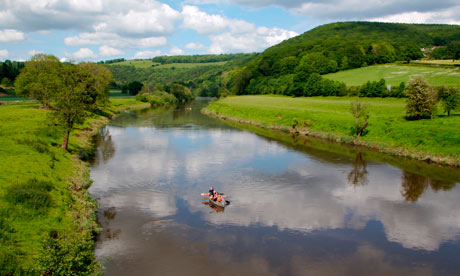
pg128 I think the passage on page 128 was interesting in the sense that I have never thought of boundaries in that sense. De Certeau talks about how boundaries can turn into pathways. Some examples of such pathways are doors, rivers, trees, and picket fences. Each can be thought of a boundary or a frontier as they prevent one from crossing to the other side, but if one truly thinks about these forms of boundaries, they in fact, create pathways. A door can be seen as a wall or a blockade, but if one puts it into use, it can be opened. Just as a river can act as a form of division, preventing those who want to cross from getting to the other side; it also provides a pathway for one to travel across. This applies to trees and picket fences, as well. A tree can block one’s path, but at the same time it can also provide a different path for one to walk. A picket fence can block one’s being from crossing, but it provides a pathway for one’s eyes to cross. Even though each barrier has its boundaries, each boundary formed also provides a different pathway for one to cross.

Source: http://files.idealhomegarden.com/files/commons/how_to_build_a_picket_fence_2.jpg

Questions:
How does a bridge act as a boundary in the logic of ambiguity? It seems as if it has and always have formed a pathway.
Do all boundaries act within the bounds of the logic of ambiguity? For example: a wall as big as the Great Wall of China.
If a boundary ironically forms a passageway, how is it a boundary in the same sense? Or is this in theory?

Pg124

I think the most confusing part of the excerpt was the paragraph on foundation. De Certeau spoke about how a foundation exists or it does not.  I was not able to draw a point from foundations to the boundaries that he was talking about. I get the sense that he may be talking about foundation as in education foundation. If this is the case then it would somewhat make sense as one without an education foundation would, in a sense, be limited within certain boundaries.